Rewiring my brain - 4 weeks without a smartphone
A cognitive performance experiment
18 Feb 2026
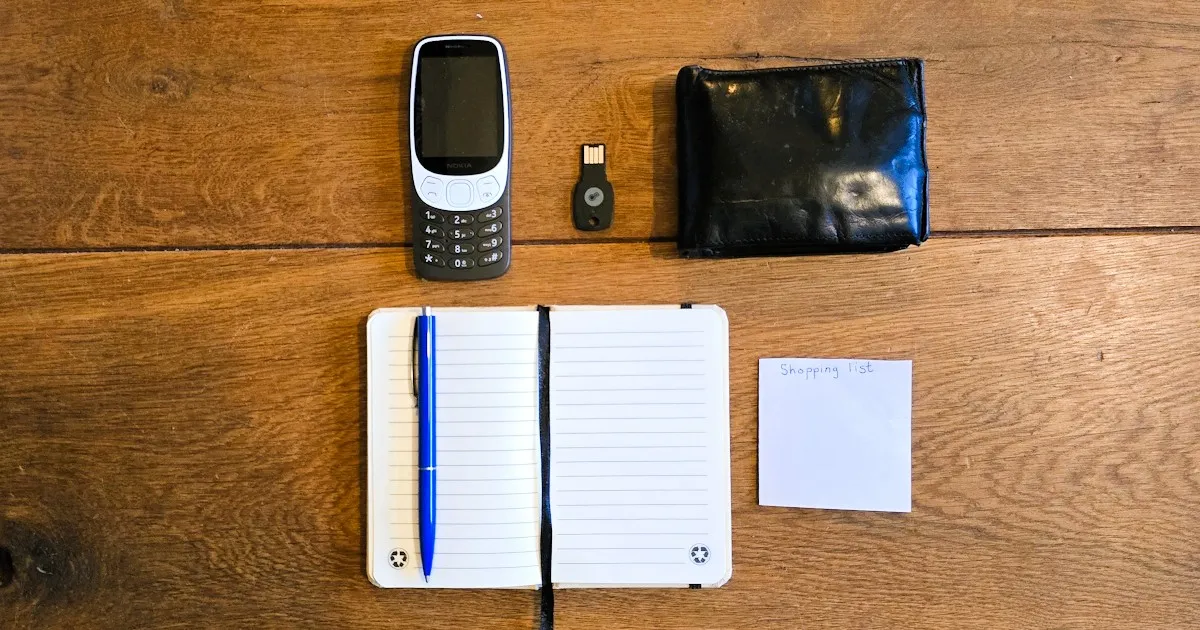
If you have a healthy relationship with your smartphone, this article is not for you. I am happy for you though. If you, like me and many others, are struggling to resist the constant pull of this magic attention destroyer you carry with you 24/7, then keep on reading. This is an overview of my journey and the latest experiment in a long line of failures.
What led up to this
I’m by nature a curious person. This attracts me to novelty, continuous learning and knowledge seeking. Keeping up with news, reading up on what others think of the state of the world, and chatting with friends and strangers over the internet was always a part of my life. In the pre-smartphone world this meant sitting behind a desktop computer in a dedicated part of the house. This was all fine and manageable. Leaving the desk meant disconnecting and being present in the real world.
This started to change around 2008-2012, with the arrival of the first smartphones. It wasn’t a big sudden shift, this happened gradually. Chat apps like WhatsApp slowly started to appear, social media apps started pulling more and more users from the desktop to the smartphone, and the beginning of mobile internet was being built. It would still take many years before smartphones were so common that every person you knew and their grandmas would own one.
Being in tech I was an early adopter of the smartphone, using it for everything. I remember back when Facebook was still a thing, I would pick up my smartphone from the nightstand first thing in the morning, open the app, and check what I’ve missed while sleeping. More and more apps were added to the mix: meme sites, Twitter, Reddit, Instagram, etc. Mainly consuming entertainment and content related to work.
Companies worked out how to keep users as long as possible on their platforms, using infinite scrolling, algorithmic feeds and endless notifications. This also worked on me. I remember doomscrolling on my phone on Twitter for hours. This was more than 10 years ago, long before doomscrolling was even coined as a term. I knew it made me miserable, unhappy and it drained my energy. I started to fight it, with various rates of success.
Becoming a parent made things worse. Being busy all the time made it harder to have hobbies, spare-time or a life. The smartphone filled in the little gaps of free time during the day, providing small moments for myself and allowing me to briefly connect with friends and family. Being a parent also means being tired. This reduces impulse-control, which makes it even harder to resist the constant distracting pull of the smartphone. This is a negative self-reinforcing loop, because doomscrolling takes away more energy, leading to less impulse-control, and so on.
Containment attempts
I have been fighting with my smartphone for quite a while now. Some things worked, like deleting the most problematic apps from my phone such as Twitter, Instagram and Reddit. But it was never truly effective. My brain would come up with ways around it, for example by using the browser version, or a different platform altogether.
To contain apps and general internet usage I tried various tools. One thing many smartphone victims have attempted is using daily limits with app timers. These seem nice, but are fundamentally flawed. Most of them, like Samsung Digital Wellbeing have an option to extend usage for the day for a few more minutes, or an easily accessible option to disable the lock for the entire day. Not using these options requires discipline, which takes energy. At some point you will be too tired to resist and you fail. It will also not solve the trickiest app: the browser. Sure, you can limit it, but at some point you will have reached the daily limit and the browser stops working. A few hours later, you want to look up something important, and the browser is locked. So, you remove the lock and you’re back at square one.
More rigorous attempts such as deleting my social media accounts altogether were more effective, especially on closed platforms with strong algorithmic feeds such as Instagram. Without an account the mobile site forces you to a login page on almost every click, making it unusable. Great!
Killing off the worst platforms gave me some relief, but did not solve the problem altogether. For a while I used Lock Me Out, which is a tamper proof app to limit websites and apps. I locked down many news sites, platforms and apps that distracted me. Technically it works great. In practice it annoyed me to death. The smartphone was such an integral part of my life that I would bounce into the locked apps and sites all the time. Someone would send me a link to a news article, which I would then try to open, planting my face in the block wall.
Reaching the threshold
In the beginning of this year my smartphone problem reached an all time high. I recently started a demanding new job and I was struggling. Things started to fall apart. I wasn’t as sharp as I used to be, had a hard time remembering things, was unable to process what was happening during the day, stress levels were way up high, I failed to pay attention to the people I care about most and generally felt bad and disconnected.
Each day I received between 100 and 200 notifications, and unlocked my phone 50-100 times. Checking for new messages and sneaking past the blocks of Lock Me Out. The app limits kept usage down to about 1 to 2 hours a day, which was not too bad on its own, but this rounded up to almost all ‘free’ time I had during a normal day.
Something had to change.
Rethinking the problem
Smartphones are great because they can do everything. It’s the only device you need, unless your work demands a bit more screen real estate. You have all the knowledge in the world in your pocket, you can chat with everyone anytime, you can get notified of ‘important’ events, constantly read your email, read your private messages at work, read your work messages at home.
This is also the root of the problem for many people. Smartphones are not time and location bound. And, they satisfy the expectation to be available for everyone all the time. Not responding to a message for 8 hours is weird. This seems like training your brain in reacting to things. Everything will come in the form of a notification, every notification can lead to checking other notifications. And even if they are silent you expect they are there and start checking to see if you missed anything. This constant checking fragments your attention, making it harder to truly connect your environment and people around you.
I started to wonder: what if I could go back to the time before smartphones, would that still hold up in 2026?
The experiment
Inspired by the book Tiny Experiments I came up with an experiment (or PACT):
For 7 days, I will only use a dumbphone to find out if this improves my mental wellbeing and cognitive abilities. My smartphone will be offline for the entire time. Each evening, I will write a short journal where I record: did I succeed, and what felt better, worse, easier, or harder that day.
In preparation I bought a Nokia 3210 4G.
My primary motivation for this slightly more expensive (€78,00) dumbphone was that it has bluetooth so it can connect to a car kit or wireless headphone, it has a basic camera, USB-C, and a simple browser. It has no touch screen, no instant messenger applications, and the Opera Mini browser is bad enough to make browsing unbearable.
I let the people around me know that I would not respond to instant messages for a week and kicked off the experiment.
Effects
In the first few days it was hard to shake the habit of constantly checking my phone. Well, I often did check my dumbphone, but nothing happened there, which made the device very boring quickly. It also meant that there were many moments where I was at a loss of what to do. Sitting on the toilet means staring at the wall in front of me. Waiting for coffee to finish: standing idly in the kitchen. Lying in bed, looking at the ceiling. There were surprisingly many of these little moments that used to be filled up by checking the smartphone. Now, especially when no-one was around, I was left alone with my brain: scary /s.
These first days were the trickiest, but the positive effects were also the most noticeable in this period. The effects came faster than expected: within 24 hours. It felt like the CPU in my head dropped from 100% to 70%. A high pressure was relieved and there was room to think, to be in the moment, and to better connect to others.
Stress levels were noticeably down, there was less brain-fog, I was less forgetful, I felt more in control, and more confident. I was more creative: it was easier to write again and my dad-jokes abilities came back. The threshold to pick up bigger tasks, plan them and execute on it felt lower.
After one week I decided to persist with the experiment to see where it might take me.
Possible explanations
I’m aware that the experienced effects are subjective and may not solely be attributable to switching to a dumbphone. Being both the ‘researcher’ as well as the subject, placebo-like effects, confirmation bias, and the subject-expectancy effect may very well have played a role. Actively taking control of my well-being could be a contributing factor to actually feeling better. Or, it may be even simpler: resting enough improves cognitive performance.
It probably also says more about me than about smartphones. I may be more affected by constant context switching and checking. More prone to distractions. Many others seem to be able to carry and use smartphones for the better, without experiencing the negative side effects.
Still, the result for me was positive and noticeable. If this felt real, science might be able to explain some of the sudden effects. Luckily, there is a lot of research and peer-reviewed papers on smartphone usage and the impact on the brain.
Science
I’m no neuroscientist or psychiatrist so I will probably not get all the details right and miss a lot of nuance but here’s what I understand so far.
A few networks in our brain are relevant to understanding what smartphones could do to the brain.
The salience network helps to detect what is important, internally and externally, and is able to activate other networks accordingly. It can act as a switch between the central executive network (CEN) and the default mode network (DMN). The central executive network is mainly responsible for focused thinking, decision-making and problem-solving. The default mode network is active when you are not focused on the outside world, but inwards. It is active when you let your mind wander, are daydreaming or thinking about the past or future. CEN and DMN are not equally active at the same time: when one is more active, the other tends to be reduced in activity.
It might be possible that my smartphone usage made the salience network more dominant, becoming more prone to stimuli. This might result in a stronger urge to check the phone. Heavy smartphone use could also be linked to increased connectivity between the salience network and the default mode network, which would mean that the default mode network becomes less stable and much more interrupted. That would make it harder to self-reflect and process what happened during the day. The default mode network is also linked to creativity. That explanation felt uncomfortably familiar. We can also look at the problem from a capacity angle. Studies indicate that we have a limited amount of cognitive resources, such as working memory. When you constantly use a part of this capacity to do stuff on your phone, it becomes harder to execute other tasks. It is not only usage of the smartphone that might demand cognitive resources, it could even be the act of avoiding looking at your phone. Some research indicates mere presence of one’s own smartphone reduces available cognitive capacity.
I fell into a neuroscience themed rabbit hole when looking into possible causes. There are many other possible scientific explanations that could play a part, such as the (well documented) effects of smartphones on dopamine release, and our inability to multitask.
Practical stuff
This sounds all good, having more time to daydream, being more deliberate in spending time, less context switching, reduced cognitive load, but… Living without a smartphone does feel like becoming a tech-hermit. Some things become much harder, or even require a smartphone to participate.
To keep up with relevant information I decided to check my messages, emails and important notifications in the morning and evening, by using the web versions of the most important apps. This is a modern version of the good old time management technique for only checking email 3 times a day. It requires a bit more planning and structure but I’ve found it easy to overcome. It does mean potentially missing messages about spontaneous plans that were arranged through instant messaging, for example when the parents of a neighborhood kid wanted to set up a last-minute play-date. This will probably be resolved when most people around me know a phone call would be a better way of reaching me for urgent communication.
Podcasts are unresolved. For me they are both a distraction, as well as good entertainment, and a valuable source of news and information. For now, I completely stopped listening. Prime podcast time was driving and public transport. These are now moments to relax, stare out the window, think and reflect.
Google Maps / navigation is also unsolved. I am not willing to go back to using a map or pre-planned routes when I go somewhere unfamiliar. For this use-case I’ve ordered a second SIM card (MultiSIM or DUO SIM) with the same data plan, so that I can fallback to my smartphone just for navigation.
For multi-factor authentication I now use a physical security key.
There are a lot more little inconveniences, such as loyalty cards for supermarkets and stores, which can be solved by carrying physical versions. Taking good quality photos either requires bringing a smartphone in airplane mode, or bringing a photo camera.
Future
At the time of writing it has been 4 weeks since I ditched my smartphone. I don’t know when or if I’ll ever switch back. It seems like a slippery slope to start using it again, since I’ve already tried many other options to reduce usage. I might try to switch to a smartphone again in the future, making it distraction free by removing almost all notifications and using a simple launcher. For now, I will try the dumbphone for some more time. The benefits outweigh the downsides for me.
Many things require a little bit more effort and a “specialized device” or physical alternative to the smartphone. This is both a blessing and a curse. Life becomes slightly more work, but also more deliberate. The friction of changing focus is now high enough to prevent brainless context switches. There is much less multi-tasking. I use a pen and paper to make a shopping list, I have a banking card to pay for things, I need to sit down in front of a laptop to look something up or read articles.
I use a phone when I want to talk to someone.